Turkish Eggs Recipe: 5 Easy Steps to Authentic Cilbir
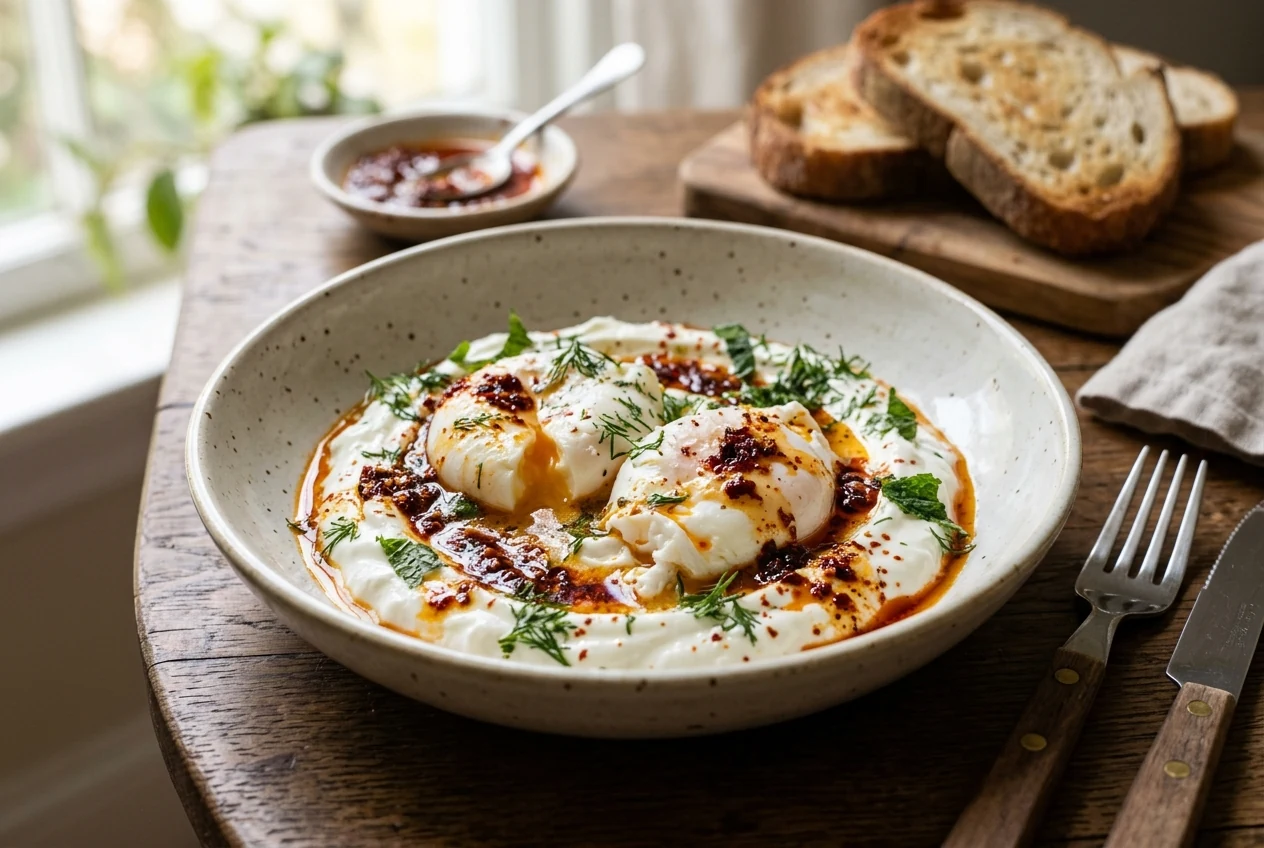
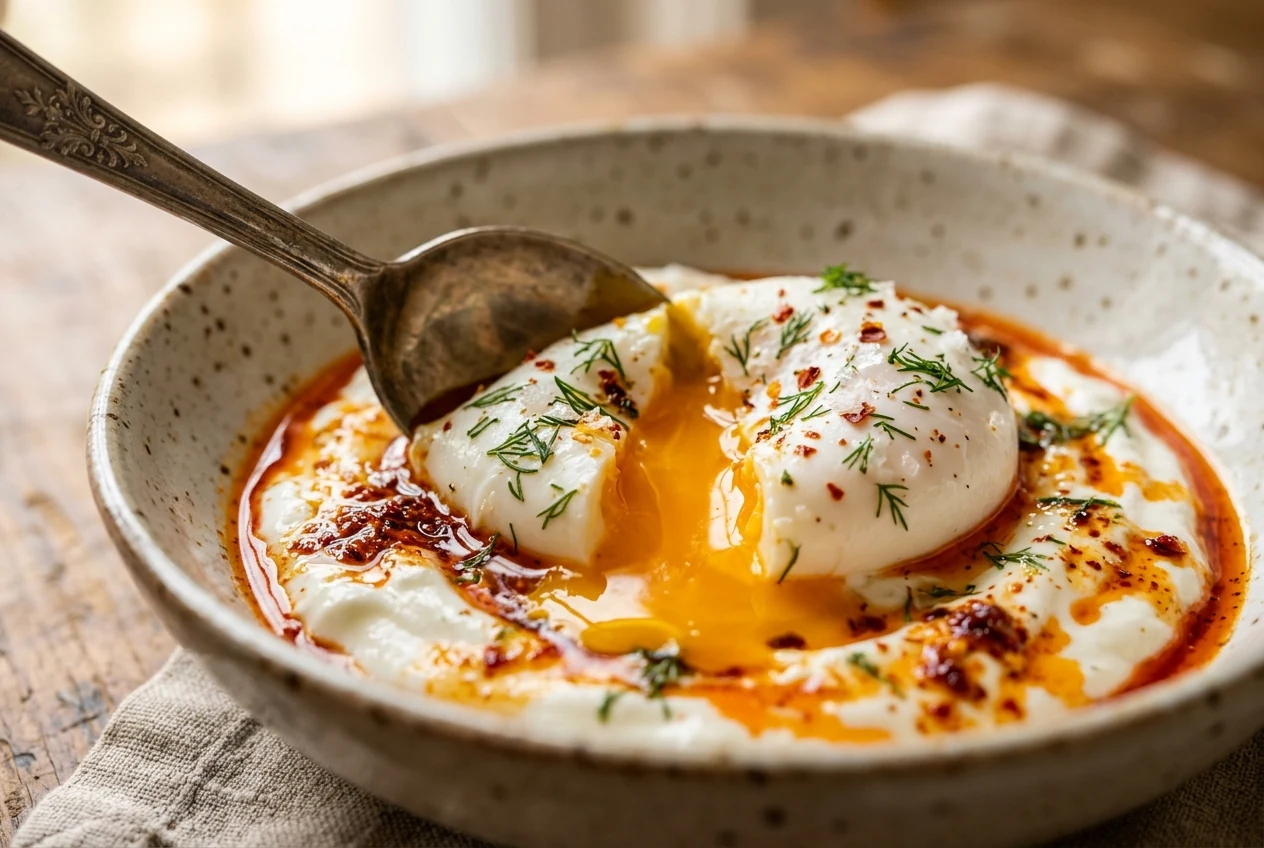
Few morning dishes in world gastronomy bridge the gap between humble pantry comfort and regal culinary sophistication quite like an authentic Turkish eggs recipe. Known in Turkish culinary heritage as Çılbır (pronounced chul-burr), this revered breakfast masterpiece transforms simple ingredients into an extraordinary symphony of contrasting textures and temperatures. Imagine sinking your fork through a delicate, tender poached egg, watching an intensely golden, runny yolk mingle with velvety, room-temperature garlic-infused yogurt, all kissed by the gentle warmth of sizzling, nutty Aleppo pepper brown butter.
Whether you have experienced Çılbır at an artisan brunch cafe or are discovering this Mediterranean treasure for the first time, learning how to prepare a foolproof Turkish eggs recipe at home will permanently elevate your weekend routine. In our kitchen on Felis Recipes, we celebrate globally inspired morning creations, from our viral Crispy Feta Fried Eggs to cloud-like Fluffy Japanese Souffle Pancakes. Today, we delve into the authentic history, kitchen science, and precise culinary techniques required to master this timeless dish in our curated Breakfast Recipes Collection.
Table of Contents
- The Royal Heritage and Cultural Significance of Çılbır
- The Three Pillar Flavor Components of an Authentic Turkish Eggs Recipe
- Yogurt Selection Science: Süzme Yoğurt, Greek Yogurt, and Labneh
- Essential Equipment for Restaurant-Quality Turkish Eggs
- Mastering the Poached Egg: Water Dynamics, Vinegar, and Sieve Straining
- The Magic of Aleppo Pepper (Pul Biber) and Spiced Brown Butter
- Step-by-Step Culinary Walkthrough: How to Make Turkish Eggs
- Nutritional Profile, Protein Power, and Mediterranean Diet Alignment
- Expert Troubleshooting Guide: Solving Common Poaching and Butter Challenges
- Artisan Bread Pairings and Serving Suggestions for Turkish Eggs
- Frequently Asked Questions About Turkish Eggs (Çılbır)
- Conclusion: Bring Istanbul Royalty to Your Breakfast Table
The Royal Heritage and Cultural Significance of Çılbır
To truly appreciate this Turkish eggs recipe, one must take a journey back in time to the majestic royal kitchens of the Ottoman Empire. Historical culinary records dating as far back as the 15th century reveal that Ottoman Sultans enjoyed poached eggs nestled in seasoned yogurt as a nourishing morning meal. In Topkapı Palace, palace chefs elevated everyday staples into royal feasts by incorporating fragrant herbs, dried peppers, and cultured dairy into daily banquets.
According to historical documentation preserved on Turkish Çılbır culinary traditions, the dish originally began as a simple rural breakfast before being embraced by imperial courts. Over centuries, the dish evolved into a beloved staple across modern Turkey, served not only for leisurely weekend breakfasts (known culturally as kahvaltı) but also as a light, protein-packed evening supper. The word kahvaltı translates literally to “before coffee”, signifying a leisurely feast meant to awaken the senses before sipping rich Turkish coffee.
What makes Çılbır enduringly popular across generations is its ingenious sensory balance. In Turkish cooking philosophy, balance is supreme: the cool, acidic tang of thick yogurt cuts through the richness of runny egg yolks, while warm spiced butter introduces nutty aroma, mild fruitiness, and gentle chile heat. It represents the quintessential Mediterranean harmony of dairy, protein, and aromatic fat.
The Three Pillar Flavor Components of an Authentic Turkish Eggs Recipe
An exceptional Turkish eggs recipe relies on three harmonious components prepared with precision and layered thoughtfully on the plate. Each element provides a distinct texture, temperature, and flavor dimension that transforms the collective bite into pure culinary alchemy:
- The Velvety Garlic-Herb Yogurt Foundation: Thick, cultured yogurt serves as the cool, tangy canvas. Fresh garlic adds piquant savory depth without overpowering the palate, while fresh dill and mint impart bright, herbaceous freshness that cuts through dairy richness.
- The Delicate, Molten-Yolk Poached Eggs: Fresh eggs poached to delicate perfection feature tender, pillowy egg whites encapsulating warm, liquid golden yolks. When pierced, the runny yolk spills forth, blending with the yogurt into an opulent, savory sauce.
- The Sizzling Spiced Aleppo Brown Butter: High-fat European butter gently melted and browned introduces toasted nutty aromas, while authentic Aleppo pepper flakes (pul biber) and smoked paprika bloom in the hot fat to create an intoxicating crimson drizzle.
When these three layers unite in a shallow bowl, every spoonful offers a dynamic contrast: cool against hot, silky against rich, and mellow acidity against gentle aromatic spice. Mastering this trifecta guarantees that your homemade Turkish eggs recipe rivals the finest Mediterranean specialty restaurants.
Yogurt Selection Science: Süzme Yoğurt, Greek Yogurt, and Labneh
In authentic Turkish households, the foundation of this dish is invariably süzme yoğurt, which translates directly to “strained yogurt”. Straining removes excess whey (the liquid byproduct of milk fermentation), yielding a dense, spreadable consistency packed with concentrated protein, calcium, and lactic acid cultures. Selecting the appropriate yogurt is paramount to avoiding a watery puddle beneath your hot eggs.
When preparing this Turkish eggs recipe outside of Turkey, authentic süzme yoğurt can easily be found in Middle Eastern or Mediterranean grocers. However, whole milk Greek yogurt makes a magnificent alternative when properly prepared. Avoid non-fat or low-fat dairy varieties, as their higher water content and lower fat percentage will cause the yogurt to separate and turn unpleasantly runny when contacted by warm butter.
For home cooks seeking the ultimate indulgent experience, Middle Eastern labneh can also be used. To help you choose the best dairy foundation for your palate and kitchen pantry, examine the detailed characteristics in the comparative analysis below:
| Yogurt Variety | Texture & Moisture Content | Flavor Profile & Acidity | Protein & Fat Density | Suitability for Turkish Eggs Recipe |
|---|---|---|---|---|
| Traditional Turkish Süzme Yoğurt | Ultra-thick, spreadable, minimal free whey | Bright, clean lactic tang with natural sweetness | High protein (10g/100g), Whole milk (8-10% fat) | Authentic gold standard; holds shape under warm butter |
| Whole Milk Greek Yogurt (5% to 10%) | Thick, creamy, slightly softer than Süzme | Pleasantly tart, rich, creamy finish | High protein (9g/100g), Rich milk fat (5-10% fat) | Ideal everyday supermarket choice; whisks effortlessly |
| Middle Eastern Labneh | Dense, cream cheese-like consistency | Pronounced sharpness, deeply tangy, savory | Very high protein (11g/100g), Dense fat (9-11% fat) | Luxurious option; best thinned with 1 tbsp olive oil |
| Standard Plain American Yogurt | Thin, fluid, high free whey separation | Mild, acidic, watery aftertaste | Moderate protein (5g/100g), Low to medium fat | Not recommended; turns watery immediately under heat |
A vital culinary rule for this Turkish eggs recipe is temperature management: never use cold yogurt straight from the refrigerator. Plating piping-hot poached eggs and sizzling melted butter onto ice-cold yogurt will immediately seize the butterfat, solidify the rich liquid into grainy clumps, and drastically cool your eggs before you take your first bite. Remove your yogurt from the refrigerator 20 to 30 minutes before serving, or warm the ceramic bowl slightly in warm water, so the dairy rests at pleasant room temperature.
Essential Equipment for Restaurant-Quality Turkish Eggs
Achieving culinary perfection does not require an industrial kitchen, but having the right tools on hand makes preparing a flawless Turkish eggs recipe stress-free and efficient:
- Fine-Mesh Sieve (Strainer): The secret weapon of professional breakfast chefs. Straining cold raw eggs removes watery, loose outer albumen that creates unsightly strings in poaching water.
- Small Ramekins or Prep Cups: Holding strained eggs in individual cups allows you to slide them into simmering water gently and safely without breaking yolks.
- Deep Stainless Steel Saucepan: A pot with at least 3 to 4 inches of water depth gives the egg room to submerge, curl, and form an aesthetically pleasing teardrop sphere.
- Slotted Spoon or Spider: Enables you to gently retrieve poached eggs while allowing excess water to drain back into the pan.
- Paper Towel-Lined Plate: Briefly resting poached eggs on paper towels absorbs lingering water droplets, preventing diluted, soggy yogurt on your plate.
- Small Skillet or Saucier: A lightweight skillet allows precise temperature control when foaming butter and blooming Aleppo pepper flakes without scorching.
- Shallow Ceramic Bowls: Broad, shallow bowls showcase the vibrant visual contrasts of white yogurt, golden eggs, crimson butter, and green herbs.
Mastering the Poached Egg: Water Dynamics, Vinegar, and Sieve Straining
For many aspiring home cooks, egg poaching can seem intimidating. However, egg poaching is not an art of luck; it is a disciplined practice of culinary physics and food chemistry. According to in-depth research on egg science published by Serious Eats egg poaching techniques, fresh eggs consist of two types of egg white (albumen): a firm, gelatinous inner white that hugs the yolk tightly, and a thin, watery outer white that breaks apart into ghostly wisps when submerged in water.
By straining your cracked egg through a fine-mesh sieve for 10 seconds before cooking, the loose outer albumen drains away cleanly, leaving only the firm, cohesive core. When this strained egg enters the poaching bath, it retains a tight, smooth, oval shape that looks like it emerged from a Michelin-starred kitchen.
Water temperature is the second critical factor. Boiling water at 212°F (100°C) produces violent, turbulent bubbles that violently tear delicate albumen apart. Instead, keep your poaching water at a gentle simmer between 180°F and 190°F (82°C to 88°C), where small bubbles form lazily on the bottom of the pot. Furthermore, adding a splash of mild vinegar lowers the water pH, helping egg proteins coagulate and set faster. Adhering to standards outlined by the USDA Food Safety and Inspection Service egg safety guidelines, cooking egg whites until completely set while keeping yolks warm and fluid guarantees both supreme culinary texture and food safety.
| Poaching Stage | Water Temperature | Visual Water Cues | Cooking Duration | Resulting Texture |
|---|---|---|---|---|
| Sub-Simmer (Too Cool) | Below 175°F (79°C) | Completely still surface, no steam | 4+ minutes | Whites spread flat, sluggish coagulation |
| Gentle Sweet-Spot Simmer | 180°F – 190°F (82°C – 88°C) | Tiny lazy bubbles at pot bottom, gentle steam | 3 minutes flat | Silky tender set whites, molten golden runny yolk |
| Rolling Boil (Too Hot) | 212°F (100°C) | Violent surface churning, heavy bubbles | 2 minutes | Torn ragged whites, rubbery texture, broken yolks |
Should you use the famous whirlpool or vortex technique? When poaching one or two eggs at a time, creating a gentle whirlpool by stirring the water in a circular motion with a spoon helps draw the egg whites around the yolk into a neat sphere. When cooking four eggs simultaneously for a family brunch, omit the vortex; simply lower the heat to maintain a calm, quiet simmer, slide the strained eggs in one by one around the perimeter, and let them cook undisturbed for exactly 3 minutes.
The Magic of Aleppo Pepper (Pul Biber) and Spiced Brown Butter
The crowning glory of this Turkish eggs recipe is the aromatic chile butter, known in Turkish cuisine as pul biberli tereyağı. To understand this component, one must understand Aleppo pepper (named after the historic northern Syrian city along the ancient Silk Road, and widely cultivated across southern Turkey where it is known as Halaby pepper or pul biber).
Unlike sharp, incendiary crushed red pepper flakes or cayenne pepper, authentic Aleppo pepper possesses a mild, fruit-forward heat level (measuring approximately 10,000 Scoville Heat Units, roughly half the heat of a jalapeño). It features a distinct naturally sun-dried, slightly oily texture with nuanced notes of dried sun-ripened tomatoes, sweet raisins, and a subtle tangy earthiness. When Aleppo pepper flakes hit warm melted butter, their fat-soluble carotenoid pigments dissolve into the butterfat, infusing the liquid with a brilliant, luminous ruby-red color and mouthwatering aroma.
To take this butter to the next level of culinary artistry, we combine gentle browning technique with spice blooming. By melting unsalted European butter (which has a higher butterfat content of 82% to 84% compared to standard American butter) alongside a touch of extra virgin olive oil, milk proteins toast gently into golden hazelnut-scented brown butter (beurre noisette). The small addition of olive oil raises the smoke point, preventing the delicate milk solids from burning. The moment the butter foams and turns lightly golden, take the pan off the heat, add the Aleppo pepper flakes and a touch of smoked paprika, and let the residual heat bloom the spices safely.
Step-by-Step Culinary Walkthrough: How to Make Turkish Eggs
Follow these 5 straightforward, foolproof steps to prepare this show-stopping Turkish eggs recipe in just 20 minutes from start to finish:
Step 1: Whip the Seasoned Garlic Yogurt
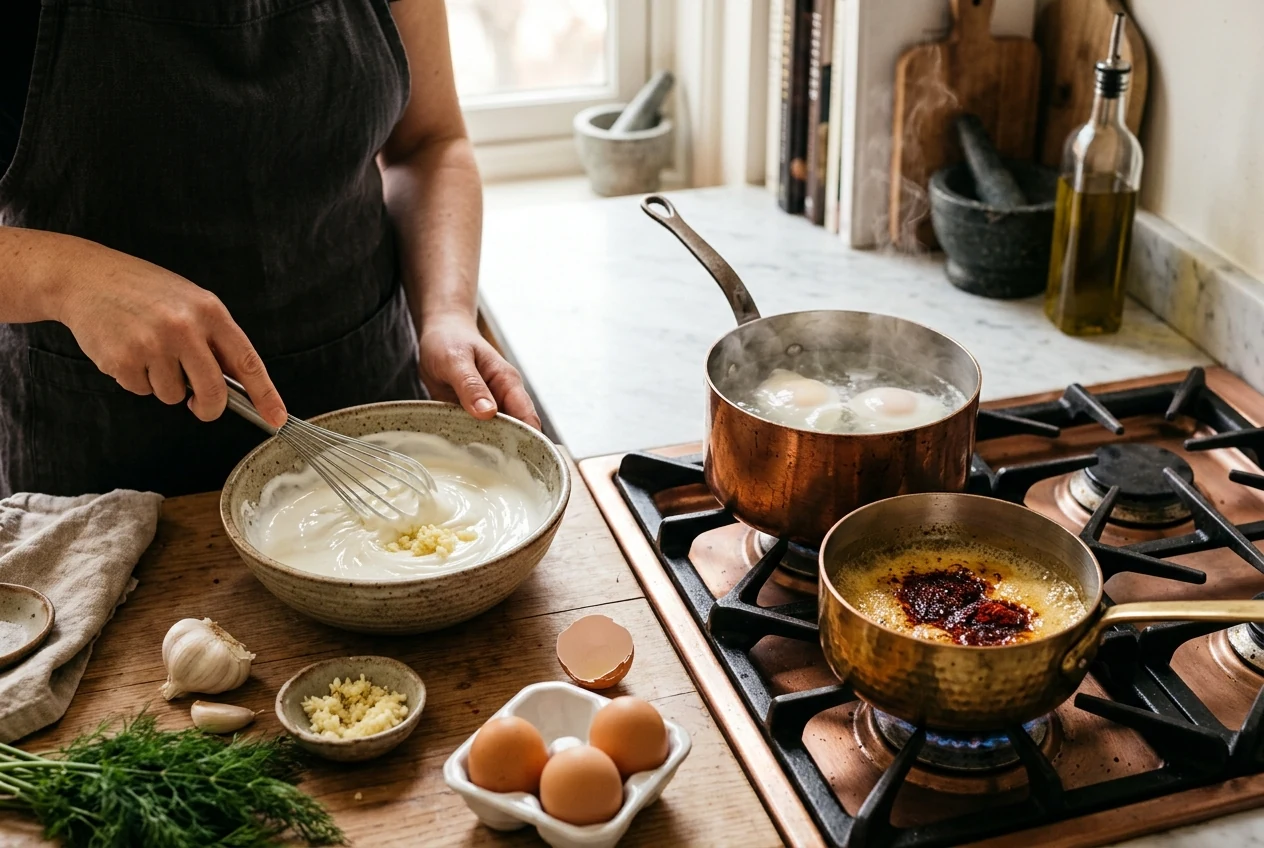
In a mixing bowl, combine 1 1/2 cups of room-temperature whole milk Greek yogurt, two finely grated or microplaned garlic cloves, 1 tablespoon of finely chopped fresh dill, 1 tablespoon of fresh mint, 1/4 teaspoon of fine sea salt, and a pinch of black pepper. Whisk vigorously for 60 seconds until the yogurt becomes aerated, velvety, and glossy. Divide the yogurt between two broad, shallow ceramic bowls. Using the back of your spoon, spread the yogurt toward the edges while swirling deep valleys in the center. These shallow crevices will catch the golden egg yolks and ruby butter later. Set the bowls aside at comfortable room temperature.
Step 2: Heat the Poaching Water and Strain the Eggs
Fill a deep saucepan with 3 to 4 inches of fresh water. Add 2 tablespoons of mild vinegar and 1/4 teaspoon of salt. Bring the liquid to a gentle boil, then reduce the heat until tiny, quiet bubbles rise lazily to the surface (180°F to 190°F / 82°C to 88°C). While the water heats, crack one cold egg into a fine-mesh strainer set over a bowl. Gently roll the egg in the strainer for 10 seconds to allow thin outer albumen to drain away, then gently tip the clean egg into a small ramekin. Repeat with each egg.
Step 3: Poach the Eggs to Liquid Perfection
If poaching one or two eggs, stir the simmering water in a gentle clockwise circle to create a light whirlpool in the center. Bring the ramekin close to the water surface and slide the egg smoothly into the center of the whirlpool. The swirling water will wrap the white around the yolk. Cook undisturbed for exactly 3 minutes for a warm, molten liquid yolk with firm, tender white. Using a slotted spoon, gently lift the poached egg from the water and transfer it to a paper towel-lined plate for 10 seconds to absorb excess liquid.
Step 4: Brown the Butter and Bloom the Aleppo Spices
While the eggs finish poaching, place a small skillet over medium heat. Add 4 tablespoons of European butter and 1 tablespoon of extra virgin olive oil. Allow the butter to melt, foam, and crackle. Watch closely as the foaming subsides and tiny golden specks appear on the bottom of the pan, releasing a rich nutty fragrance (about 2 minutes). Immediately remove the skillet from the burner. Stir in 1 1/2 teaspoons of Aleppo pepper flakes and 1/2 teaspoon of smoked paprika. Swirl the skillet gently for 20 to 30 seconds as the spices bloom and turn the butter an intoxicating crimson hue.
Step 5: Assemble, Garnish, and Serve Immediately
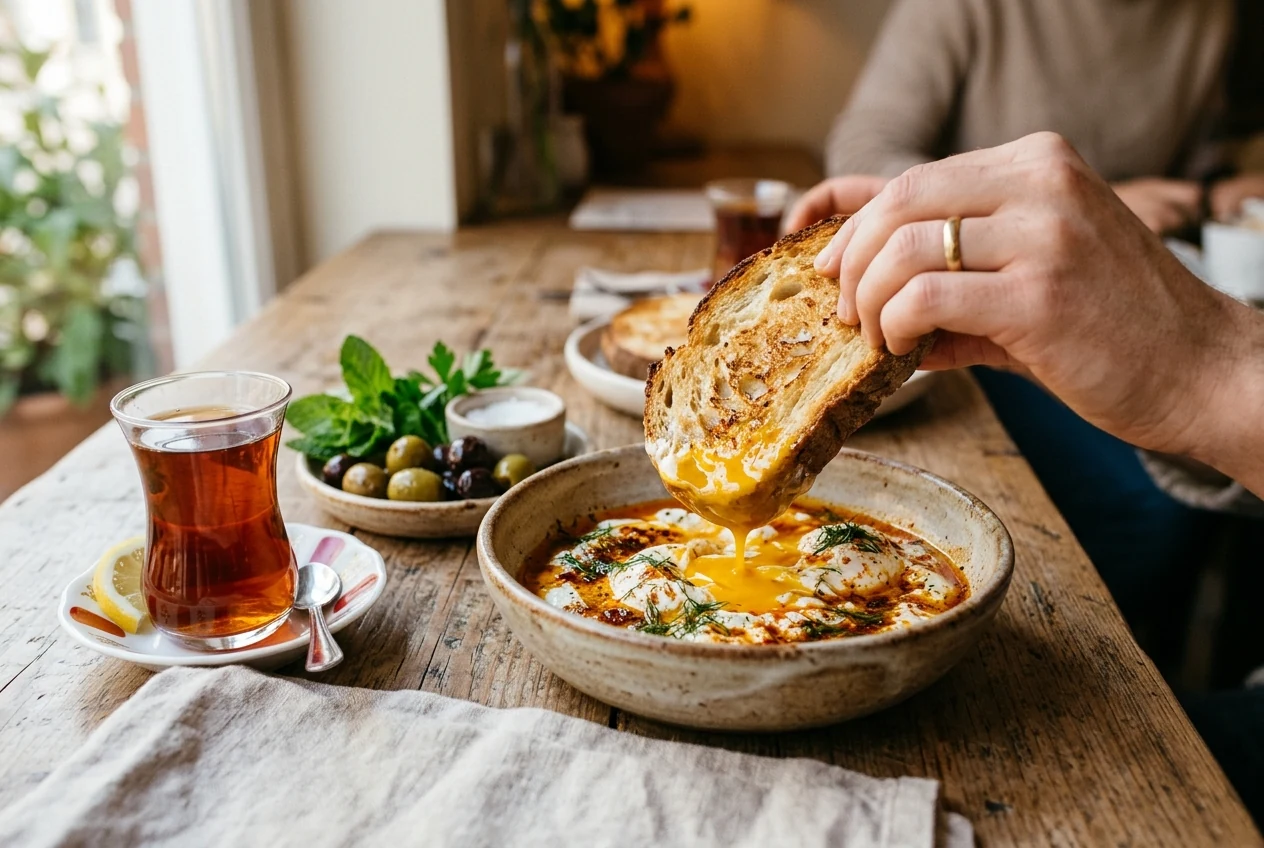
Using a spoon or offset spatula, gently nestle two warm poached eggs into the center of the whipped yogurt in each bowl. Immediately spoon the warm, sizzling Aleppo pepper butter generously over the eggs, watching it pool in the yogurt valleys. Scatter the remaining chopped fresh dill across the surface and finish with a pinch of crunchy flaky Maldon sea salt. Serve immediately with warm, crusty toasted artisan sourdough or flatbread.
Nutritional Profile, Protein Power, and Mediterranean Diet Alignment
Beyond its luxurious mouthfeel and vibrant aesthetic appeal, this authentic Turkish eggs recipe aligns seamlessly with the principles of the wholesome Mediterranean diet. Nutritionists and culinary experts celebrate Mediterranean eating patterns for their emphasis on fermented dairy, nutrient-dense proteins, healthy unrefined fats, and anti-inflammatory culinary herbs.
Eggs represent one of nature’s most complete nutrient powerhouses, providing high-biological-value protein containing all nine essential amino acids. Egg yolks are particularly abundant in choline (vital for brain cell signaling and liver metabolic health), lutein and zeaxanthin (potent antioxidants that protect retinal eye health), and bioavailable vitamin D, vitamin B12, and selenium.
Simultaneously, strained Greek yogurt contributes substantial probiotic benefits from live active cultures that support gut microbiome diversity. Unlike sugary breakfast cereals or refined pastries that trigger sharp blood glucose spikes followed by mid-morning fatigue, this protein-rich, low-carbohydrate breakfast provides sustained energy, robust satiety, and stable insulin levels throughout your morning. Each satisfying serving provides approximately 19 grams of complete protein, healthy fats from pasture butter and olive oil, and minimal simple carbohydrates.
Expert Troubleshooting Guide: Solving Common Poaching and Butter Challenges
Even seasoned home cooks occasionally face minor hiccups when preparing delicate egg dishes. Review our comprehensive troubleshooting matrix below to diagnose and remedy any issues effortlessly:
| Issue Encountered | Root Cause | Immediate Correction | Prevention for Next Time |
|---|---|---|---|
| Spidery, Ragged Poached Egg Whites | Water too turbulent, or loose outer albumen not strained | Trim ragged edges with kitchen shears before plating | Always drain raw egg in a fine-mesh sieve; keep water below rolling boil |
| Watery Puddle Diluting Garlic Yogurt | Wet eggs plated straight from poaching water onto yogurt | Gently dab edges of bowl with clean paper towel | Rest poached eggs on paper towel-lined plate for 10 seconds before plating |
| Chili Butter Congeals and Turns Grainy | Garlic yogurt was plated ice-cold straight from refrigerator | Enjoy immediately with hot toasted bread | Bring yogurt to room temperature 25 minutes prior to assembly |
| Bitter, Burnt Pepper Butter | Aleppo pepper was added to skillet while still on high burner heat | Discard and remake; butter takes only 2 minutes | Always take skillet completely off heat source before adding spices |
| Garlic Flavor Too Sharp and Harsh | Raw garlic was minced too coarsely or quantity excessive | Stir in 1 additional tablespoon of plain yogurt to mellow | Microplane garlic into fine paste and allow it to rest in yogurt for 10 mins |
If you prefer an even mellower garlic profile, try incorporating roasted garlic paste from our celebrated Ultimate Garlic Confit Recipe. Blending two cloves of caramelized confit garlic into your Greek yogurt creates an exquisitely sweet, buttery, deeply aromatic foundation that complements the spiced Aleppo butter brilliantly.
Artisan Bread Pairings and Serving Suggestions for Turkish Eggs
In Turkish culinary culture, eating Çılbır is an interactive, tactile ritual. The bread you serve is not an afterthought; it is your primary utensil. A fork may be used to pierce the egg, but every drop of silky yogurt and crimson butter belongs scooped onto warm, crusty bread.
Here are our favorite bread pairings to complete your Turkish eggs recipe:
- Rustic Crusty Sourdough: Thickly sliced sourdough with an open crumb, toasted golden and brushed with olive oil, offers ideal structural rigidity and delightful chew to scoop up velvety yogurt without getting soggy.
- Turkish Pide or Barbari Bread: Fluffy, dimpled flatbreads sprinkled with toasted sesame and nigella seeds provide authentic Middle Eastern bakery texture and subtle nutty crunch.
- Warm Charred Pita: Soft, pocket-style pita bread, warmed over an open gas flame or dry cast iron skillet, is pliable, pillowy, and delightful for tearing and dipping.
- Sourdough Focaccia: Airy, olive oil-infused focaccia with crisp edges absorbs the spiced butter into its deep dimples for decadent luxury.
To create a magnificent Mediterranean brunch spread, accompany your Turkish eggs with a refreshing side of thinly sliced Persian cucumbers, ripe heirloom cherry tomatoes, briny Kalamata olives, and tangy pickled accents from our vibrant Quick Pickled Red Onions. Serve with freshly brewed Turkish black tea in traditional tulip-shaped glasses for an unforgettable feast.
Frequently Asked Questions About Turkish Eggs (Çılbır)
Can I make Turkish eggs ahead of time?
While this Turkish eggs recipe is best enjoyed immediately upon assembly, you can prepare the garlic-herb yogurt base up to 24 hours in advance and store it tightly covered in the refrigerator. Remember to remove the yogurt 30 minutes before serving so it returns to room temperature. Poached eggs can also be pre-cooked, chilled in an ice bath, and gently reheated in warm water (140°F / 60°C) for 60 seconds just before plating.
What can I substitute for Aleppo pepper (pul biber)?
If you cannot find authentic Turkish Aleppo pepper flakes, create a close substitute by combining 3 parts sweet Spanish smoked paprika with 1 part crushed red pepper flakes or cayenne pepper. A pinch of ground cumin or sumac can also replicate the fruity, tangy undertones characteristic of genuine Aleppo chile.
Is it possible to use fried eggs instead of poached eggs?
Yes, absolutely. While poached eggs are the classic traditional Ottoman standard, fried eggs with crispy golden edges and runny yolks (similar to our technique in Crispy Feta Fried Eggs) taste phenomenal over garlic yogurt and Aleppo butter. Sunny-side-up or soft-boiled eggs (boiled for 6 minutes and peeled) also work wonderfully.
Can I use dried herbs instead of fresh dill and mint?
While fresh dill and mint deliver unmatched vibrancy and aroma, dried mint (kuru nane) is actually deeply rooted in Turkish culinary tradition. If using dried mint, use half the amount (about 1/2 teaspoon) and stir it directly into the yogurt or bloom it in the warm butter alongside the Aleppo pepper.
Conclusion: Bring Istanbul Royalty to Your Breakfast Table
Mastering this authentic Turkish eggs recipe unlocks a timeless culinary masterpiece that transforms simple pantry ingredients into a dining experience fit for royalty. From the cool, creamy tang of whipped garlic Greek yogurt to the velvety warmth of molten golden yolks and the nutty crimson splendor of Aleppo brown butter, every mouthful is a celebration of balanced Mediterranean flavors.
Gather your ingredients, slice a fresh loaf of crusty sourdough, warm your teapot, and treat yourself and your loved ones to this spectacular dish this weekend. Explore our extensive library of morning inspiration across our Breakfast Recipes Collection, and bring the rich culinary heritage of Istanbul into your home kitchen today.
Authentic Turkish Eggs (Çılbır)
-
Total Time:
20 mins -
Yield:
2 servings 1x
Description
Authentic Turkish eggs recipe (Çılbır) featuring velvety garlic-infused Greek yogurt, delicate poached eggs, and warm Aleppo pepper brown butter. Served with crusty artisan bread for the ultimate savory brunch.
Ingredients
Scale
- 1 1/2 cups (360g) whole milk Greek yogurt or traditional Turkish süzme yoğurt, brought to room temperature
- 2 medium cloves fresh garlic, finely grated or crushed with a pinch of salt
- 2 tablespoons finely chopped fresh dill, divided
- 1 tablespoon finely chopped fresh mint leaves
- 1/2 teaspoon fine sea salt, divided
- 1/4 teaspoon freshly cracked black pepper
- 4 large fresh pasture-raised eggs, cold from the refrigerator
- 2 tablespoons distilled white vinegar or apple cider vinegar (for the poaching bath)
- 4 tablespoons (56g) unsalted European-style butter
- 1 tablespoon extra virgin olive oil
- 1 1/2 teaspoons Turkish Aleppo pepper flakes (pul biber)
- 1/2 teaspoon smoked paprika or sweet paprika
- Flaky Maldon sea salt, for finishing
- Thick slices of toasted rustic sourdough or warm pita bread, for serving
Instructions
- Prepare the Whipped Garlic Yogurt Base: In a medium mixing bowl, whisk together the room temperature Greek yogurt, finely grated garlic, 1 tablespoon of chopped dill, chopped mint, 1/4 teaspoon of fine sea salt, and black pepper until completely smooth, silky, and aerated. Divide the mixture evenly between two shallow ceramic serving bowls. Using the back of a spoon, create shallow swirls and valleys across the surface to catch the warm chili butter later. Set aside at room temperature.
- Set Up the Poaching Water: Fill a deep, wide saucepan with at least 3 to 4 inches of water. Add 2 tablespoons of vinegar and 1/4 teaspoon of salt. Bring to a gentle boil over medium heat, then reduce the heat so the water maintains a gentle simmer (around 185°F to 190°F / 85°C to 88°C) with tiny bubbles rising slowly to the surface.
- Poach the Eggs to Perfection: Crack one cold egg into a fine-mesh sieve set over a small bowl and gently swirl for 10 seconds to drain away the loose, watery outer albumen. Transfer the egg into a small ramekin. Repeat with the remaining eggs. Using a spoon or spatula, stir the simmering water in a circular motion to create a gentle vortex in the center. Carefully tip the egg from the ramekin directly into the center of the whirlpool. Poach for 3 minutes for a luscious, warm, liquid yolk and tender set white. Remove with a slotted spoon and briefly blot on a paper towel-lined plate.
- Sizzle the Aleppo Pepper Butter: While the eggs are poaching, melt the unsalted butter and olive oil in a small skillet over medium heat. Allow the butter to foam and begin crackling gently as milk solids turn lightly golden and fragrant (about 2 minutes). Remove the skillet from the heat and immediately stir in the Aleppo pepper flakes and smoked paprika. Swirl the pan for 20 to 30 seconds as the spices bloom, releasing their aromatic oils and turning the butter a vibrant crimson red.
- Assemble, Garnish, and Serve: Carefully place two poached eggs on top of the garlic yogurt in each bowl. Immediately spoon the sizzling, warm Aleppo chili butter generously over the eggs and into the yogurt crevices. Sprinkle with the remaining chopped fresh dill and crunchy flakes of Maldon sea salt. Serve immediately with warm toasted sourdough or crusty flatbread.
Notes
Ensure your yogurt is at room temperature before plating. Cold yogurt straight from the refrigerator will chill the hot poached eggs and congeal the warm spiced butter. For the cleanest poached eggs, always strain watery albumen through a fine mesh sieve before sliding the egg into simmering water.
- Prep Time: 10 mins
- Cook Time: 10 mins
- Category: Breakfast
- Cuisine: Turkish / Mediterranean
window.trCommon={“minRating”:6,”ajaxurl”:”https://felisrecipes.com/wp-admin/admin-ajax.php”,”ratingNonce”:”79119b1721″,”postId”:12843};
window.TastyRecipes = window.TastyRecipes || {};
window.TastyRecipes.smoothScroll = {
init() {
document.addEventListener( ‘click’, ( e ) => {
let anchor = e.target;
if ( anchor.tagName !== ‘A’ ) {
anchor = anchor.closest( ‘a.tasty-recipes-scrollto’ );
}
if ( ! anchor || ! anchor.classList.contains( ‘tasty-recipes-scrollto’ ) ) {
return;
}
const elementHref = anchor.getAttribute( ‘href’ );
if ( ! elementHref ) {
return;
}
e.preventDefault();
this.goToSelector( elementHref );
});
},
goToSelector( selector ) {
const element = document.querySelector( selector );
if ( ! element ) {
return;
}
element.scrollIntoView( { behavior: ‘smooth’ } );
}
};
document.addEventListener(
‘DOMContentLoaded’,
() => window.TastyRecipes.smoothScroll.init()
);
(function(){
var bothEquals = function( d1, d2, D ) {
var ret = 0;
if (d1<=D) {
ret++;
}
if (d2<=D) {
ret++;
}
return ret === 2;
};
var frac =function frac(x,D,mixed){var n1=Math.floor(x),d1=1;var n2=n1+1,d2=1;if(x!==n1){while(bothEquals(d1,d2,D)){var m=(n1+n2)/(d1+d2);if(x===m){if(d1+d2d2){d2=D+1;}else {d1=D+1;}break}else if(xD){d1=d2;n1=n2}if(!mixed){return[0,n1,d1];}var q=Math.floor(n1/d1);return[q,n1-q*d1,d1]};frac.cont=function cont(x,D,mixed){var sgn=x<0?-1:1;var B=x*sgn;var P_2=0,P_1=1,P=0;var Q_2=1,Q_1=0,Q=0;var A=Math.floor(B);while(Q_1<D){A=Math.floor(B);P=A*P_1+P_2;Q=A*Q_1+Q_2;if(B-AD){if(Q_1>D){Q=Q_2;P=P_2}else{Q=Q_1;P=P_1}}if(!mixed){return[0,sgn*P,Q];}var q=Math.floor(sgn*P/Q);return[q,sgn*P-q*Q,Q]};
window.tastyRecipesVulgarFractions = JSON.parse(decodeURIComponent(“%7B%22%C2%BC%22%3A%221%2F4%22%2C%22%C2%BD%22%3A%221%2F2%22%2C%22%C2%BE%22%3A%223%2F4%22%2C%22%E2%85%93%22%3A%221%2F3%22%2C%22%E2%85%94%22%3A%222%2F3%22%2C%22%E2%85%95%22%3A%221%2F5%22%2C%22%E2%85%96%22%3A%222%2F5%22%2C%22%E2%85%97%22%3A%223%2F5%22%2C%22%E2%85%98%22%3A%224%2F5%22%2C%22%E2%85%99%22%3A%221%2F6%22%2C%22%E2%85%9A%22%3A%225%2F6%22%2C%22%E2%85%9B%22%3A%221%2F8%22%2C%22%E2%85%9C%22%3A%223%2F8%22%2C%22%E2%85%9D%22%3A%225%2F8%22%2C%22%E2%85%9E%22%3A%227%2F8%22%7D”));
window.tastyRecipesFormatAmount = function(amount, el) {
if ( parseFloat( amount ) === parseInt( amount ) ) {
return amount;
}
var roundType = ‘frac’;
if (typeof el.dataset.amountShouldRound !== ‘undefined’) {
if (‘false’ !== el.dataset.amountShouldRound) {
if ( ‘number’ === el.dataset.amountShouldRound ) {
roundType = ‘number’;
} else if (‘frac’ === el.dataset.amountShouldRound) {
roundType = ‘frac’;
} else if (‘vulgar’ === el.dataset.amountShouldRound) {
roundType = ‘vulgar’;
} else {
roundType = ‘integer’;
}
}
}
if (‘number’ === roundType) {
amount = Number.parseFloat(amount).toPrecision(2);
} else if (‘integer’ === roundType) {
amount = Math.round(amount);
} else if (‘frac’ === roundType || ‘vulgar’ === roundType) {
var denom = 8;
if (typeof el.dataset.unit !== ‘undefined’) {
var unit = el.dataset.unit;
if ([‘cups’,’cup’,’c’].includes(unit)) {
denom = 4;
if (0.125 === amount) {
denom = 8;
}
if (“0.1667″ === Number.parseFloat( amount ).toPrecision(4)) {
denom = 6;
}
}
if ([‘tablespoons’,’tablespoon’,’tbsp’].includes(unit)) {
denom = 2;
}
if ([‘teaspoons’,’teaspoon’,’tsp’].includes(unit)) {
denom = 8;
}
}
var amountArray = frac.cont( amount, denom, true );
var newAmount = ”;
if ( amountArray[1] !== 0 ) {
newAmount = amountArray[1] + ‘/’ + amountArray[2];
if (‘vulgar’ === roundType) {
Object.keys(window.tastyRecipesVulgarFractions).forEach(function(vulgar) {
if (newAmount === window.tastyRecipesVulgarFractions[vulgar]) {
newAmount = vulgar;
}
});
}
}
if ( newAmount ) {
newAmount = ‘ ‘ + newAmount;
}
if ( amountArray[0] ) {
newAmount = amountArray[0] + newAmount;
}
amount = newAmount;
}
return amount;
};
window.tastyRecipesUpdatePrintLink = () => {
const printButton = document.querySelector( ‘.tasty-recipes-print-button’ );
if ( ! printButton ) {
return;
}
const printURL = new URL( printButton.href );
const searchParams = new URLSearchParams( printURL.search );
const unitButton = document.querySelector( ‘.tasty-recipes-convert-button-active’ );
const scaleButton = document.querySelector( ‘.tasty-recipes-scale-button-active’ );
let unit = ”;
let scale = ”;
if ( unitButton ) {
unit = unitButton.dataset.unitType;
searchParams.delete(‘unit’);
searchParams.set( ‘unit’, unit );
}
if ( scaleButton ) {
scale = scaleButton.dataset.amount;
searchParams.set( ‘scale’, scale );
}
const paramString = searchParams.toString();
const newURL = ” === paramString ? printURL.href : printURL.origin + printURL.pathname + ‘?’ + paramString;
const printLinks = document.querySelectorAll( ‘.tasty-recipes-print-link’ );
printLinks.forEach( ( el ) => {
el.href = newURL;
});
const printButtons = document.querySelectorAll( ‘.tasty-recipes-print-button’ );
printButtons.forEach( ( el ) => {
el.href = newURL;
});
};
document.addEventListener( ‘DOMContentLoaded’, () => {
if ( ! window.location.href.includes( ‘/print/’ ) ) {
return;
}
const searchParams = new URLSearchParams( window.location.search );
const unit = searchParams.get( ‘unit’ );
const scale = searchParams.get( ‘scale’ );
if ( unit && ( ‘metric’ === unit || ‘usc’ === unit ) ) {
document.querySelector( ‘.tasty-recipes-convert-button[data-unit-type=”‘ + unit + ‘”]’ ).click();
}
if ( scale && Number(scale) > 0 ) {
document.querySelector( ‘.tasty-recipes-scale-button[data-amount=”‘ + Number(scale) + ‘”]’ ).click();
}
});
}());
(function(){
var buttonClass = ‘tasty-recipes-scale-button’,
buttonActiveClass = ‘tasty-recipes-scale-button-active’,
buttons = document.querySelectorAll(‘.tasty-recipes-scale-button’);
if ( ! buttons ) {
return;
}
buttons.forEach(function(button){
button.addEventListener(‘click’, function(event){
event.preventDefault();
var recipe = event.target.closest(‘.tasty-recipes’);
if ( ! recipe ) {
return;
}
var otherButtons = recipe.querySelectorAll(‘.’ + buttonClass);
otherButtons.forEach(function(bt){
bt.classList.remove(buttonActiveClass);
});
button.classList.add(buttonActiveClass);
var scalables = recipe.querySelectorAll(‘span[data-amount]’);
var buttonAmount = parseFloat( button.dataset.amount );
scalables.forEach(function(scalable){
if (typeof scalable.dataset.amountOriginalType === ‘undefined’
&& typeof scalable.dataset.nfOriginal === ‘undefined’) {
if (-1 !== scalable.innerText.indexOf(‘/’)) {
scalable.dataset.amountOriginalType = ‘frac’;
}
if (-1 !== scalable.innerText.indexOf(‘.’)) {
scalable.dataset.amountOriginalType = ‘number’;
}
Object.keys(window.tastyRecipesVulgarFractions).forEach(function(vulgar) {
if (-1 !== scalable.innerText.indexOf(vulgar)) {
scalable.dataset.amountOriginalType = ‘vulgar’;
}
});
if (typeof scalable.dataset.amountOriginalType !== ‘undefined’) {
scalable.dataset.amountShouldRound = scalable.dataset.amountOriginalType;
}
}
var amount = parseFloat( scalable.dataset.amount ) * buttonAmount;
amount = window.tastyRecipesFormatAmount(amount, scalable);
if ( typeof scalable.dataset.unit !== ‘undefined’ ) {
if ( ! scalable.classList.contains(‘nutrifox-quantity’) ) {
if ( ! scalable.classList.contains(‘nutrifox-second-quantity’) ) {
amount += ‘ ‘ + scalable.dataset.unit;
}
}
}
scalable.innerText = amount;
});
var nonNumerics = recipe.querySelectorAll(‘[data-has-non-numeric-amount]’);
nonNumerics.forEach(function(nonNumeric){
var indicator = nonNumeric.querySelector(‘span[data-non-numeric-label]’);
if ( indicator ) {
nonNumeric.removeChild(indicator);
}
if ( 1 !== buttonAmount ) {
indicator = document.createElement(‘span’);
indicator.setAttribute(‘data-non-numeric-label’, true);
var text = document.createTextNode(‘ (x’ + buttonAmount + ‘)’);
indicator.appendChild(text);
nonNumeric.appendChild(indicator);
}
});
window.tastyRecipesUpdatePrintLink();
});
});
}());
(function() {
document.querySelectorAll(‘.tasty-recipes-copy-button’).forEach(function(copyButton) {
if (copyButton.getAttribute(‘data-tasty-recipes-click-event’)) {
return;
}
copyButton.setAttribute(‘data-tasty-recipes-click-event’, true);
copyButton.addEventListener(‘click’, function(event) {
event.preventDefault();
var copyContainer = copyButton.closest(‘.tasty-recipes-ingredients-clipboard-container’);
var messageText = copyButton.attributes.getNamedItem(‘data-success’).nodeValue;
var copySuccessMessage = document.createElement(‘div’);
var copySuccessParagraph = document.createElement(‘p’);
copySuccessParagraph.innerText = messageText;
copySuccessMessage.appendChild(copySuccessParagraph);
copySuccessMessage.classList.add(‘tasty-recipes-flash-message’);
var messageDuration = 3000;
var ingredients = [];
var ingredientsContainer = copyButton.closest(‘.tasty-recipes-ingredients’) || copyButton.closest(‘.tasty-recipe-ingredients’);
var foundIngredients = false;
var findIngredients = function(div) {
if ( div.querySelectorAll(‘li’).length ) {
div.querySelectorAll(‘li’).forEach(function(li) {
ingredients.push(li.innerText);
});
foundIngredients = true;
} else if ( div.querySelectorAll(‘p’).length ) {
div.querySelectorAll(‘p’).forEach(function(p) {
ingredients.push(p.innerText);
});
foundIngredients = true;
}
};
if (ingredientsContainer.querySelector(‘.tasty-recipes-ingredients-body’)) {
findIngredients(ingredientsContainer.querySelector(‘.tasty-recipes-ingredients-body’));
} else {
ingredientsContainer.querySelectorAll(‘div’).forEach(function(div) {
if ( foundIngredients ) {
return;
}
if ( div.classList.contains(‘tasty-recipes-ingredients-header’)
|| div.parentElement.classList.contains(‘tasty-recipes-ingredients-header’)
|| div.classList.contains(‘tasty-recipes-ingredients-header’) ) {
return;
}
findIngredients(div);
});
}
var readableIngredients = ”;
ingredients.forEach(function(ingredient) {
readableIngredients += ingredient + ‘n’;
});
readableIngredients = readableIngredients.trim();
var fakeElem = document.createElement(“textarea”);
fakeElem.style.fontSize = “12pt”;
fakeElem.style.border = “0”;
fakeElem.style.padding = “0”;
fakeElem.style.margin = “0”;
fakeElem.style.position = “absolute”;
fakeElem.style.left = “-9999px”;
var yPosition = window.pageYOffset || document.documentElement.scrollTop;
fakeElem.style.top = yPosition + ‘px’;
fakeElem.setAttribute(“readonly”, “”);
fakeElem.value = readableIngredients;
document.body.appendChild(fakeElem);
if (navigator.userAgent.match(/ipad|iphone/i)) {
var range = document.createRange();
var selection = window.getSelection();
range.selectNodeContents(fakeElem);
selection.removeAllRanges();
selection.addRange(range);
fakeElem.setSelectionRange(0, 999999);
} else {
fakeElem.select();
}
document.execCommand(“copy”);
document.body.removeChild(fakeElem);
fakeElem = null;
copyContainer.appendChild(copySuccessMessage);
setTimeout(function() {
copyContainer.removeChild(copySuccessMessage);
}, messageDuration);
});
});
}());
(function(){
document.querySelectorAll(‘[data-tr-ingredient-checkbox]’).forEach(function(el) {
var input = el.querySelector(‘.tr-ingredient-checkbox-container input[type=”checkbox”]’);
if ( ! input ) {
return;
}
if (input.checked) {
el.dataset.trIngredientCheckbox = ‘checked’;
}
el.addEventListener(‘click’, function(event) {
if ( ‘A’ === event.target.nodeName
|| ‘INPUT’ === event.target.nodeName
|| ‘LABEL’ === event.target.nodeName ) {
return;
}
input.click();
});
input.addEventListener(‘change’, function() {
el.dataset.trIngredientCheckbox = input.checked ? ‘checked’ : ”;
});
});
}());
window.TastyRecipes = window.TastyRecipes || {};
window.TastyRecipes.staticTooltip = {
element: null,
tooltipElement: null,
deleting: false,
init( element ) {
if ( this.deleting ) {
return;
}
this.element = element;
this.buildElements();
},
destroy() {
if ( ! this.tooltipElement || this.deleting ) {
return;
}
this.deleting = true;
this.tooltipElement.classList.remove( ‘opened’ );
setTimeout( () => {
this.tooltipElement.remove();
this.deleting = false;
}, 500 );
},
buildElements() {
const tooltipElement = document.createElement( ‘div’ );
tooltipElement.classList.add( ‘tasty-recipes-static-tooltip’);
tooltipElement.setAttribute( ‘id’, ‘tasty-recipes-tooltip’ );
const currentTooltipElement = document.getElementById( ‘tasty-recipes-tooltip’ );
if ( currentTooltipElement ) {
document.body.replaceChild( tooltipElement, currentTooltipElement );
} else {
document.body.appendChild( tooltipElement );
}
this.tooltipElement = document.getElementById( ‘tasty-recipes-tooltip’ );
},
show() {
if ( ! this.tooltipElement ) {
return;
}
const tooltipTop = this.element.getBoundingClientRect().top
+ window.scrollY
– 10 // 10px offset.
– this.tooltipElement.getBoundingClientRect().height;
const tooltipLeft = this.element.getBoundingClientRect().left
– ( this.tooltipElement.getBoundingClientRect().width / 2 )
+ ( this.element.getBoundingClientRect().width / 2 ) – 1;
const posLeft = Math.max( 10, tooltipLeft );
this.maybeRemoveTail( posLeft !== tooltipLeft );
this.tooltipElement.setAttribute( ‘style’, ‘top:’ + tooltipTop + ‘px;left:’ + posLeft + ‘px;’ );
this.tooltipElement.classList.add( ‘opened’ );
},
maybeRemoveTail( removeTail ) {
if ( removeTail ) {
this.tooltipElement.classList.add( ‘tr-hide-tail’ );
} else {
this.tooltipElement.classList.remove( ‘tr-hide-tail’ );
}
},
changeMessage( message ) {
if ( ! this.tooltipElement ) {
return;
}
this.tooltipElement.innerHTML = message;
}
};
window.TastyRecipes.ajax = {
sendPostRequest( url, data, success, failure ) {
const xhr = new XMLHttpRequest();
xhr.open( ‘POST’, url, true );
xhr.send( this.preparePostData( data ) );
xhr.onreadystatechange = () => {
if ( 4 !== xhr.readyState ) {
return;
}
if ( xhr.status === 200 ) {
success( JSON.parse( xhr.responseText ) );
return;
}
failure( xhr );
};
xhr.onerror = () => {
failure( xhr );
};
},
preparePostData( data ) {
const formData = new FormData();
for ( const key in data ) {
formData.append( key, data[key] );
}
return formData;
},
};
window.TastyRecipes.ratings = {
defaultRating: 0,
currentRatingPercentage: 100,
savingRating: false,
init( minRating ) {
this.minRating = minRating;
this.formWatchRating();
this.closeTooltipWhenClickOutside();
this.addBodyClassBasedOnSelectedRating();
this.backwardCompFormRatingPosition();
},
formWatchRating() {
const ratings = document.querySelectorAll(‘.tasty-recipes-no-ratings-buttons [data-rating]’);
if ( ratings.length {
event.preventDefault();
this.defaultRating = event.target.closest( ‘.checked’ ).dataset.rating;
this.setCheckedStar( event.target );
this.maybeSendRating( this.defaultRating, event.target );
this.setRatingInForm( this.defaultRating );
} );
}
},
closeTooltipWhenClickOutside() {
window.addEventListener( ‘click’, e => {
// Bailout (don’t remove the tooltip) when the clicked element is a rating star, or it’s the tooltip itself.
if ( e.target.closest( ‘.tasty-recipes-rating’ ) || e.target.classList.contains( ‘tasty-recipes-static-tooltip’ ) ) {
return;
}
window.TastyRecipes.staticTooltip.destroy();
} );
},
setRatingInForm( rating ) {
const ratingInput = document.querySelector( ‘#respond .tasty-recipes-rating[value=”‘ + rating + ‘”]’ );
if ( ! ratingInput ) {
return;
}
ratingInput.click();
},
addBodyClassBasedOnSelectedRating() {
const ratingInputs = document.querySelectorAll( ‘input.tasty-recipes-rating’ );
if ( ! ratingInputs ) {
return;
}
for ( const ratingInput of ratingInputs ) {
ratingInput.addEventListener( ‘click’, currentEvent => {
const selectedRating = currentEvent.target.getAttribute( ‘value’ );
this.handleBodyClassByRating( selectedRating );
this.toggleCommentTextareaRequired( selectedRating );
} );
}
},
handleBodyClassByRating( rating ) {
if ( rating < this.minRating ) {
document.body.classList.remove( 'tasty-recipes-selected-minimum-rating' );
return;
}
document.body.classList.add( 'tasty-recipes-selected-minimum-rating' );
},
toggleCommentTextareaRequired( rating ) {
const commentTextarea = document.getElementById( 'comment' );
if ( ! commentTextarea ) {
return;
}
if ( rating {
window.TastyRecipes.staticTooltip.changeMessage( response.data.message );
window.TastyRecipes.staticTooltip.show();
this.updateAverageText( response.data, recipeCardElement );
this.maybeFillCommentForm( response.data );
// Hide the tooltip after 5 seconds.
setTimeout( () => {
this.maybeResetTooltip( recipeCardElement, response.data, rating );
}, 5000 );
},
() => {
this.resetTooltip( recipeCardElement );
}
);
},
updateAverageText( data, recipeCardElement ) {
if ( ! data.average ) {
return;
}
this.setRatingPercent( data );
if ( ! data.count ) {
return;
}
const quickLink = document.querySelector( ‘.tasty-recipes-rating-link’ );
if ( quickLink ) {
this.setTextInContainer( quickLink, data );
this.setPartialStar( quickLink );
}
const cardStars = recipeCardElement.querySelector( ‘.tasty-recipes-ratings-buttons’ );
cardStars.dataset.trDefaultRating = data.average;
this.setTextInContainer( recipeCardElement.querySelector( ‘.tasty-recipes-rating’ ), data );
},
setTextInContainer( container, data ) {
if ( ! container ) {
return;
}
if ( data.label ) {
const ratingLabelElement = container.querySelector( ‘.rating-label’ );
if ( ratingLabelElement ) {
ratingLabelElement.innerHTML = data.label;
}
return;
}
const averageElement = container.querySelector( ‘.average’ );
if ( averageElement ) {
averageElement.textContent = data.average;
}
const countElement = container.querySelector( ‘.count’ );
if ( countElement ) {
countElement.textContent = data.count;
}
},
setPartialStar( container ) {
const highestStar = container.querySelector( ‘[data-rating=”‘ + Math.ceil( this.defaultRating ) + ‘”]’ );
if ( highestStar ) {
highestStar.dataset.trClip = this.currentRatingPercentage;
}
},
setRatingPercent( data ) {
this.defaultRating = data.average.toFixed( 1 );
const parts = data.average.toFixed( 2 ).toString().split( ‘.’ );
this.currentRatingPercentage = parts[1] ? parts[1] : 100;
if ( this.currentRatingPercentage === ’00’ ) {
this.currentRatingPercentage = 100;
}
},
setCheckedStar( target ) {
const cardRatingContainer = target.closest( ‘.tasty-recipes-ratings-buttons’ );
const selectedRatingElement = cardRatingContainer.querySelector( ‘[data-tr-checked]’ );
if ( selectedRatingElement ) {
delete selectedRatingElement.dataset.trChecked;
}
const thisStar = target.closest( ‘.tasty-recipes-rating’ );
thisStar.dataset.trChecked = 1;
thisStar.querySelector( ‘[data-tr-clip]’ ).dataset.trClip = 100;
},
maybeFillCommentForm( data ) {
if ( ! data.comment || ! data.comment.content ) {
return;
}
const commentForm = document.querySelector( ‘#commentform’ );
if ( ! commentForm ) {
return;
}
const commentBox = commentForm.querySelector( ‘[name=comment]’ );
if ( ! commentBox || commentBox.value ) {
return;
}
// Add comment details for editing.
commentBox.innerHTML = data.comment.content;
if ( data.comment.name ) {
commentForm.querySelector( ‘[name=author]’ ).value = data.comment.name;
commentForm.querySelector( ‘[name=email]’ ).value = data.comment.email;
}
},
maybeResetTooltip( recipeCardElement, data, rating ) {
if ( this.savingRating === rating ) {
this.resetTooltip( recipeCardElement, data );
}
},
resetTooltip( recipeCardElement, data ) {
window.TastyRecipes.staticTooltip.destroy();
this.savingRating = false;
// Reset the default rating.
const cardRatingContainer = recipeCardElement.querySelector( ‘.tasty-recipes-ratings-buttons’ );
if ( cardRatingContainer ) {
this.defaultRating = ( data && data.average ) ? data.average.toFixed(1) : cardRatingContainer.dataset.trDefaultRating;
cardRatingContainer.dataset.trDefaultRating = this.defaultRating;
this.resetSelectedStar( cardRatingContainer, data );
}
},
resetSelectedStar( cardRatingContainer ) {
const selectedRatingElement = cardRatingContainer.querySelector( ‘[data-rating=”‘ + Math.ceil( this.defaultRating ) + ‘”]’ );
if ( selectedRatingElement ) {
selectedRatingElement.querySelector( ‘[data-tr-clip]’ ).dataset.trClip = this.currentRatingPercentage;
selectedRatingElement.parentNode.dataset.trChecked = 1;
}
const previousSelectedElement= cardRatingContainer.querySelector( ‘[data-tr-checked]’ );
if ( previousSelectedElement ) {
const currentSelectedRating = previousSelectedElement.querySelector(‘[data-rating]’);
if ( currentSelectedRating !== selectedRatingElement ) {
delete previousSelectedElement.dataset.trChecked;
}
}
},
backwardCompFormRatingPosition() {
const ratingsButtons = document.querySelector( ‘#respond .tasty-recipes-ratings-buttons, #tasty-recipes-comment-rating .tasty-recipes-ratings-buttons’ );
if ( ! ratingsButtons ) {
return;
}
const ratingsButtonsStyles = window.getComputedStyle(ratingsButtons);
if ( ! ratingsButtonsStyles.display.includes( ‘flex’ ) ) {
ratingsButtons.style.direction = ‘rtl’;
}
if ( typeof tastyRecipesRating !== ‘undefined’ ) {
// Select the rating that was previously selected in admin.
ratingsButtons.querySelector( ‘.tasty-recipes-rating[value=”‘ + tastyRecipesRating + ‘”]’ ).checked = true;
}
const ratingSpans = ratingsButtons.querySelectorAll( ‘.tasty-recipes-rating’ );
for (const ratingSpan of ratingSpans) {
ratingSpan.addEventListener( ‘click’, event => {
if ( ratingSpan === event.target ) {
return;
}
ratingSpan.previousElementSibling.click();
} );
}
}
};
(function(callback) {
if (document.readyState !== “loading”) {
callback();
} else {
window.addEventListener( ‘load’, callback );
}
})(() => {
window.TastyRecipes.ratings.init( window.trCommon ? window.trCommon.minRating : 4 );
});