
Fluffy Japanese Souffle Pancakes Recipe: 5 Easy Steps to Cloud-Like Fluff
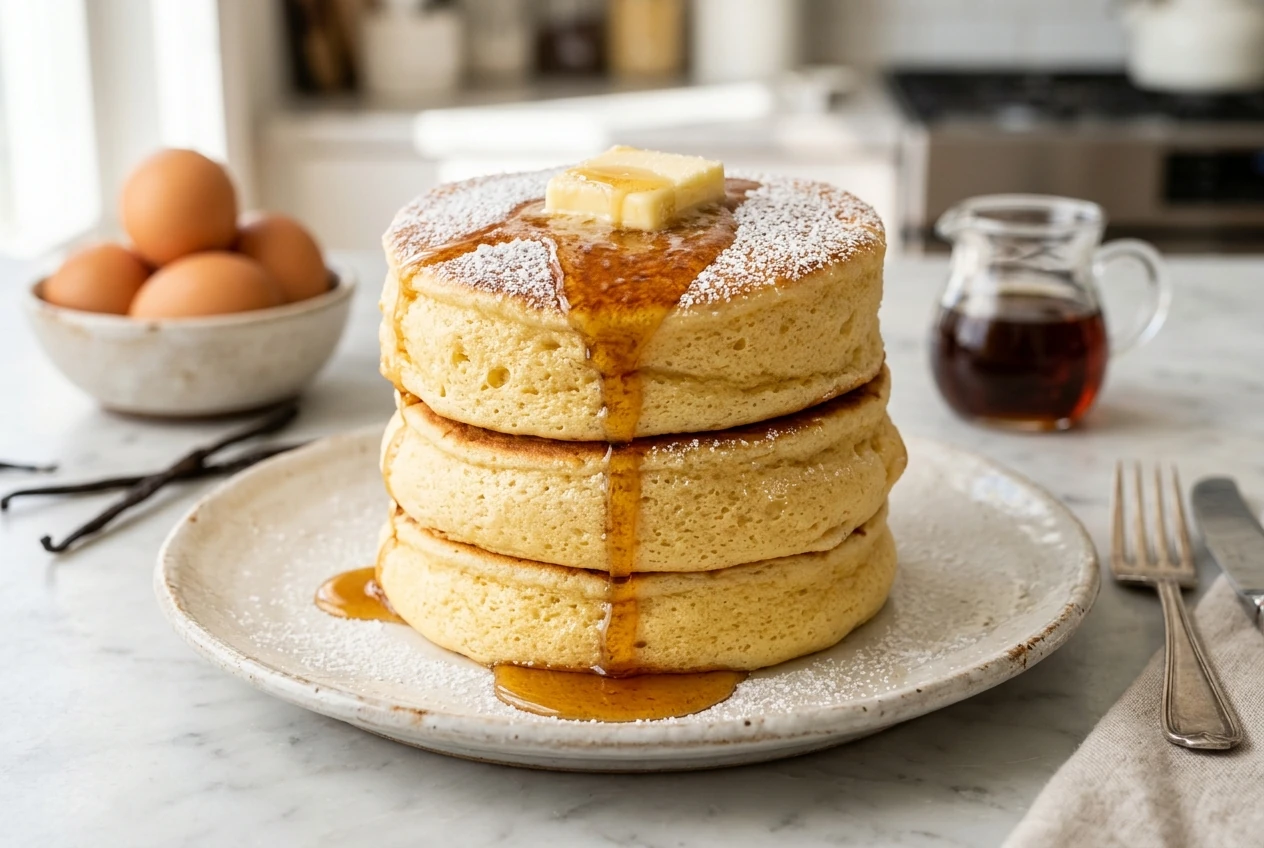
If you have ever dreamed of biting into breakfast that tastes like an ethereal, sweet, vanilla-scented cloud, this foolproof Fluffy Japanese Souffle Pancakes recipe will completely transform your morning culinary repertoire. Originating in bustling Tokyo specialty cafes and capturing millions of viral views across Pinterest and social media feeds worldwide, these towering, delicately jiggly breakfast wonders represent the pinnacle of pancake pastry artistry. Unlike conventional dense American buttermilk flapjacks, authentic Fluffy Japanese Souffle Pancakes rely on the scientific precision of French meringue aeration and low-temperature skillet steam to produce a towering, golden-bronzed delicacy that literally dissolves on your tongue.
Whether you are crafting a lavish Sunday brunch spread, surprising family members with an unforgettable weekend treat, or elevating your morning comfort food routine alongside our savory Crispy Feta Fried Eggs or luxurious chocolate creations in our Breakfast Recipes Collection on Felis Recipes, this comprehensive masterclass delivers the exact bakery-tested techniques you need for guaranteed sky-high success.
Table of Contents
- The Culinary Science of Fluffy Japanese Souffle Pancakes: Why They Jiggle
- Essential Ingredients for Fluffy Japanese Souffle Pancakes
- The Secret to the Perfect French Meringue Technique
- Cooking Temperature & Steam Technique Comparison Table
- Step-by-Step Instructions: How to Make Fluffy Japanese Souffle Pancakes
- Troubleshooting Guide: Why Did My Souffle Pancakes Deflate?
- Delicious Flavor Variations and Topping Inspirations
- Nutritional Profile & Macro Breakdown
- Make-Ahead, Reheating & Storing Guidelines
- Frequently Asked Questions (FAQs)
The Culinary Science of Fluffy Japanese Souffle Pancakes: Why They Jiggle
To understand what elevates Fluffy Japanese Souffle Pancakes far above standard griddle cakes, one must examine the fascinating culinary chemistry occurring inside the batter. Traditional pancake recipes depend almost exclusively on chemical leaveners like baking soda and baking powder reacting with acidic buttermilk to produce pockets of carbon dioxide. While effective for creating a tender crumb, chemical leavening alone can never support the dramatic two-inch vertical rise characteristic of Tokyo-style soufflé pancakes.
Instead, the true structural foundation of Fluffy Japanese Souffle Pancakes is mechanical aeration achieved through a stabilized egg white foam, known in classical French pastry as meringue. When egg whites are whipped vigorously, the folded proteins (primarily ovalbumin and ovotransferrin) unfold and realign, forming an elastic mesh that encapsulates millions of microscopic air bubbles. When subjected to the controlled, gentle heat of a covered skillet, the trapped air expands while the moisture converts into steam. This dual expansion inflates the pancake batter like a miniature hot air balloon.
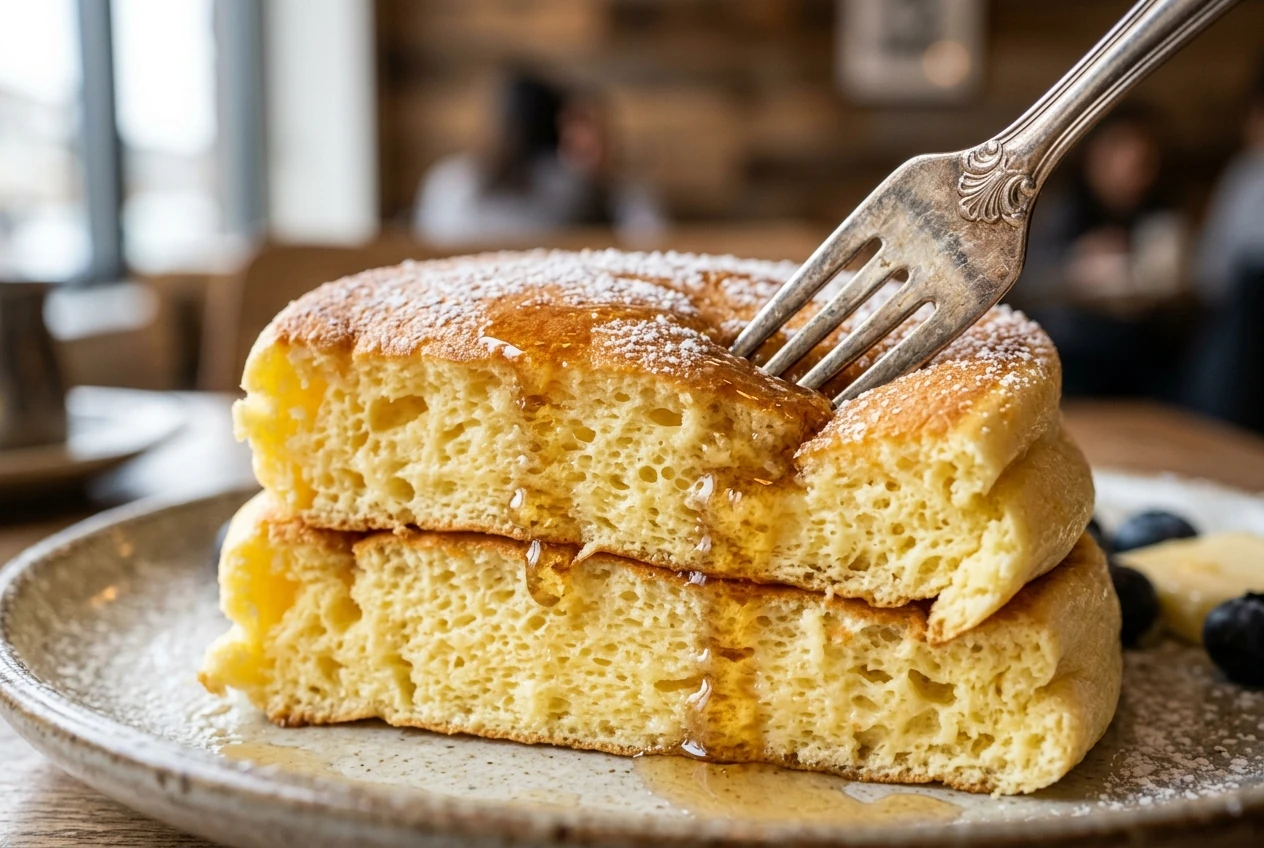
Simultaneously, the minimal amount of flour provides just enough starch gelatinization and gluten matrix to set the delicate foam structure before it cools. This delicate balance between expanding air cells and a lightly set protein framework creates the iconic signature “jiggle” when you gently shake the plate, yielding a texture that food scientists classify between a baked custard and a classic French dessert soufflé.
Essential Ingredients for Fluffy Japanese Souffle Pancakes
Achieving bakery-level perfection with Fluffy Japanese Souffle Pancakes requires simple pantry staples, but the quality, temperature, and measurement of each component play a pivotal role in the final rise. Here is the curated breakdown of ingredients needed for foolproof execution:
- Fresh Grade-A Large Eggs: The undisputed heart of the recipe. Fresh eggs possess thicker, more acidic egg white proteins that whip into substantially firmer and more stable meringues than older, watery eggs. As documented by culinary researchers at Exploratorium Science of Cooking, fresher albumens resist collapsing during folding and cooking.
- Granulated White Sugar: Sugar does far more than sweeten; it acts as a molecular stabilizer. By dissolving into the water layer surrounding egg white protein films, sugar delays protein coagulation and prevents over-whipping, ensuring a glossy, flexible meringue.
- Low-Protein Cake Flour: Using Japanese cake flour or bleached pastry flour with a protein content around 7% to 8% is recommended. Lower gluten development ensures that the crumb remains cloud-soft rather than chewy or rubbery. If cake flour is unavailable, simply sift all-purpose flour together with a small pinch of cornstarch.
- Whole Milk: A single tablespoon of rich whole milk loosens the egg yolk base, providing optimal hydration to activate the starch granules without thinning the batter.
- Double-Acting Baking Powder: While the meringue provides 90% of the vertical lift, half a teaspoon of double-acting baking powder offers a secondary heat-activated boost in the skillet, ensuring the pancakes stay tall and puffed.
- Cream of Tartar (Potassium Bitartrate): The essential pastry secret. An acid that lowers the pH of the egg whites, cream of tartar strengthens the protein bonds, making the meringue resilient against deflation during the crucial folding step.
- Pure Vanilla Bean Extract: Masks any eggy aroma and infuses the warm interior with deep, aromatic floral sweetness.
- Filtered Water (For Skillet Steam): A few teaspoons of water added around the perimeter of the pan create an enclosed steam chamber, baking the delicate center while preventing scorched bottoms.
The Secret to the Perfect French Meringue Technique
Whipping the egg whites properly is where 95% of amateur attempts either succeed gloriously or fall flat. When preparing your meringue for Fluffy Japanese Souffle Pancakes, strict adherence to professional pastry protocols is non-negotiable:
First, ensure that your mixing bowl and beaters are impeccably clean. Even a microscopic trace of oil, butter, or broken egg yolk can coat the egg white proteins, completely preventing them from forming stable air pockets. Opt for stainless steel, glass, or copper bowls rather than plastic, which easily retains residual cooking oils.
Second, separate your eggs while they are cold straight from the refrigerator, as cold yolks are firmer and far less prone to breaking. However, allow the separated egg whites to rest at room temperature for roughly 10 minutes before whipping; warmer proteins exhibit lower surface tension and expand into greater volume.
Third, control your whipping speed. Do not rush the process by starting on high speed. Begin on medium-low speed until the whites become uniformly frothy like sea foam. Add the cream of tartar, then gradually stream in the granulated sugar in three equal increments. Once the sugar is fully incorporated, elevate the speed to medium-high. Whip until the meringue achieves stiff, glossy peaks that hold their shape proudly with just a slight curl at the very tip. If you whip past this stage into dry, clumpy chunks, the meringue will lose its elasticity and separate in the pan.
Cooking Temperature & Steam Technique Comparison Table
Managing stove heat is the second critical pillar. Traditional American pancakes cook quickly on a sizzling 375°F (190°C) griddle. In contrast, Fluffy Japanese Souffle Pancakes demand low, gentle conduction combined with humid convection. Below is a comparative overview highlighting why the closed steam method is mandatory:
| Cooking Method | Internal Texture | Vertical Rise | Risk of Collapse |
|---|---|---|---|
| High Heat / Open Skillet | Raw runny center with charred blackened exterior | Poor (< 1 inch) | Extreme (Deflates instantly upon flipping) |
| Medium Heat / No Steam | Dense, dry, sponge-cake consistency | Moderate (1 to 1.25 inches) | High (Wrinkles within 2 minutes) |
| Ultra-Low Heat + Steam Under Lid (Optimal) | Ultra-custardy, moist, cloud-like melt | Exceptional (2 to 2.5 inches tall) | Minimal (Maintains towering structure) |
As documented in master pastry research by Serious Eats, enclosing the skillet creates an ambient sauna environment where water vapor conducts heat evenly across the exposed batter dome, setting the exterior structure while the bottom slowly bronzes without burning.
Step-by-Step Instructions: How to Make Fluffy Japanese Souffle Pancakes
Follow these 5 meticulously detailed steps to execute bakery-quality Fluffy Japanese Souffle Pancakes in your home kitchen:
Step 1: Prepare the Enriched Egg Yolk Base
Carefully crack your cold eggs, placing the whites into a spotless glass bowl and the yolks into a separate medium mixing bowl. Whisk the yolks with 1 tablespoon of granulated sugar until the mixture lightens into a pale, creamy lemon hue. Drizzle in 1 tablespoon of whole milk and the pure vanilla extract, whisking until thoroughly incorporated. Sift 1/4 cup of cake flour and 1/2 teaspoon of baking powder directly over the bowl. Gently whisk in a figure-eight motion just until no dry pockets remain. The resulting yolk batter should be thick, smooth, and lump-free.
Step 2: Master the Stiff Meringue
Add 1/4 teaspoon of cream of tartar to the chilled egg whites. Power on your electric hand mixer to medium speed, whipping until the egg whites transform from clear liquid into an opaque, frothy lather with uniform bubbles. Without stopping the mixer, gradually sprinkle in the remaining 1 tablespoon of sugar in a thin, continuous stream. Crank the mixer to medium-high speed. Continue whipping for roughly 2.5 to 3 minutes until the foam turns into a brilliant, glossy white meringue that forms stiff, upright peaks when the beaters are gently lifted.
Step 3: The Two-Stage Sacrificial Fold
Do not dump the entire meringue into the yolk mixture at once. Take approximately one-third of your whipped meringue and vigorously stir it into the dense yolk batter. This sacrificial portion lightens the density of the base so that the remaining delicate foam can be incorporated smoothly. Next, scrape the rest of the meringue into the bowl. Using a wide, flexible silicone spatula, perform slow, deliberate folding motions: slice down through the center, sweep along the bottom of the bowl toward your body, and fold upward over the top, turning the bowl 45 degrees between each stroke. Cease folding the instant no white streaks remain.
Step 4: Stack for Monumental Height in the Pan
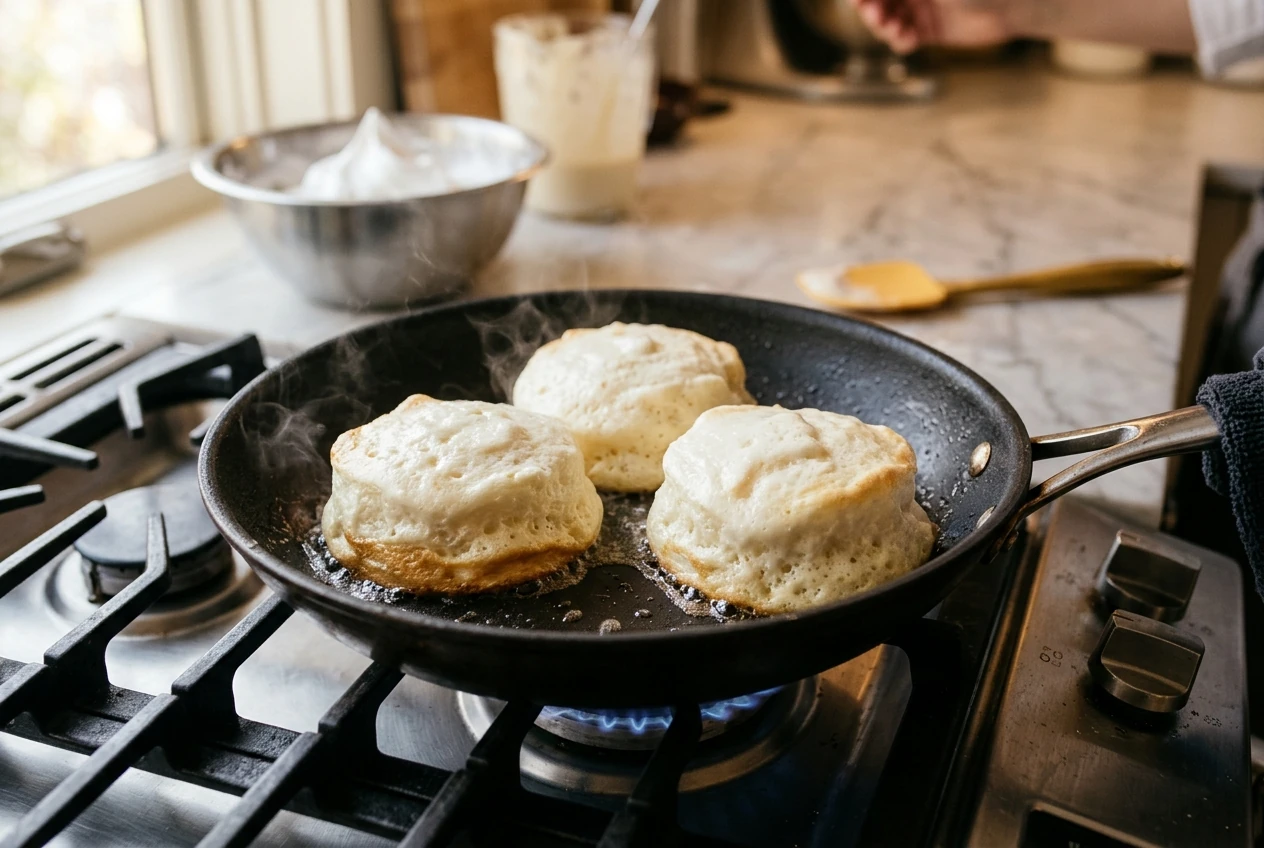
Place a heavy-bottomed, premium non-stick pan over your stove’s absolute lowest heat setting. Coat the surface lightly with a paper towel dampened with melted butter or coconut oil. Using an ice cream scoop, deposit three round dollops of batter onto the pan. Allow them to sit for 30 seconds to settle, then scoop a second generous dollop directly on top of each mound. This double-layer stacking technique is the commercial Tokyo cafe secret that produces monumental vertical height.
Step 5: The Dual Steam Bake & Gentle Turn
Drizzle 1 to 2 teaspoons of water into the empty gaps between pancakes (never directly on the batter). Trap the steam immediately with a domed lid and set a timer for 4 to 5 minutes. When you lift the lid, the pancake sides should appear set and matte rather than wet. Slide a thin fish spatula beneath each pancake and gently flip them over in one fluid motion. Add one more teaspoon of water, replace the lid, and cook for another 3 to 4 minutes until the pancakes spring back resiliently when touched on the side.
Troubleshooting Guide: Why Did My Souffle Pancakes Deflate?
Because Fluffy Japanese Souffle Pancakes rely on delicate egg proteins, understanding how to diagnose and resolve common cooking hurdles ensures consistent mastery:
- Problem: Pancakes Flattened Immediately After Flipping.
Root Cause: Under-whipped meringue or rough folding. If your meringue only reached soft peaks, the air bubbles will lack the structural strength to support the weight of the batter when turned. Alternatively, folding too aggressively deflated the trapped gas prior to hitting the skillet. Ensure your whites form firm, stiff peaks and fold with gentle, circular sweeps. - Problem: Pancakes Are Burned on the Outside but Raw/Liquid in the Middle.
Root Cause: Excessive stovetop heat. These pancakes cannot be rushed on medium or high flame. If your burner runs hot even on its lowest notch, invest in an inexpensive metal heat diffuser plate or stack two burner rings to elevate the skillet further from the flame. - Problem: The Pancakes Deflated Within 3 Minutes of Plating.
Root Cause: Natural thermal contraction or undercooking. While all soufflé-style creations settle slightly as the hot steam inside cools, catastrophic collapse indicates the internal starches and egg proteins did not fully set. Cook under the lid for an extra 60 seconds on the second side to solidify the interior structure. - Problem: The Batter Spread Wide Instead of Rising Tall.
Root Cause: Adding too much liquid or failing to stack the batter. Ensure you do not exceed the measured milk quantity, and always deposit the second scoop of batter strictly on top of the first round rather than next to it.
Delicious Flavor Variations and Topping Inspirations
While classic golden butter and grade-A amber maple syrup remain timeless, Fluffy Japanese Souffle Pancakes serve as a versatile canvas for gourmet cafe flavor profiles:
- Ceremonial Kyoto Matcha Glaze: Sift 1 teaspoon of culinary-grade Japanese matcha powder into the flour mixture, and serve topped with sweetened green tea condensed milk cream and toasted black sesame seeds.
- Boba Brown Sugar Milk Tea: Drizzle warm, caramelized brown sugar syrup and warm tapioca pearls over a velvety cloud of black tea infused whipped cream.
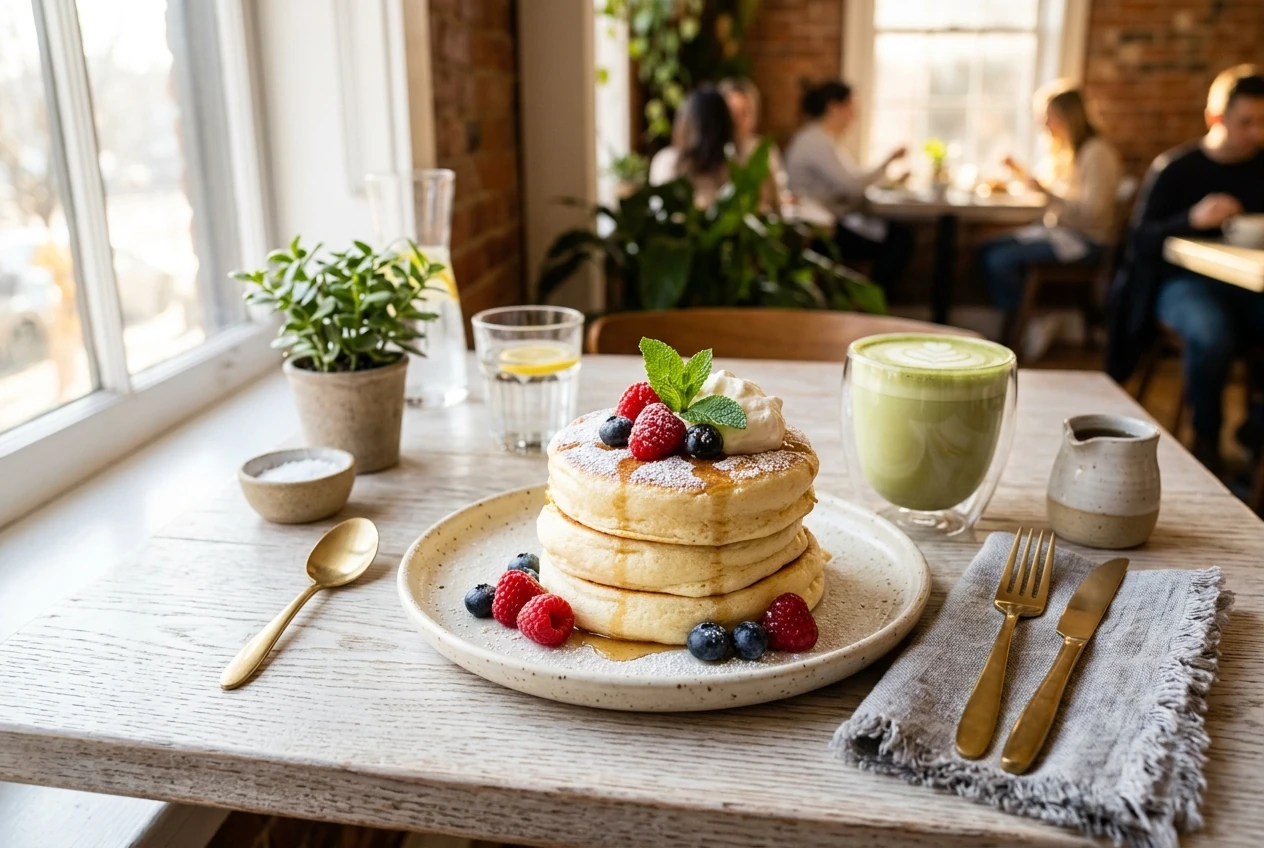
- Fresh Berry & Lemon Curd Compote: Top your warm pancakes with tart, homemade lemon curd, fresh raspberries, blackberries, and a fragrant sprig of fresh sweet mint.
- Decadent Pistachio & Kataifi Crunch: Inspired by our viral sensations like the Viral Dubai Chocolate Bar, ladle warm Sicilian pistachio cream and butter-toasted crunchy kataifi pastry threads over the golden stack.
Nutritional Profile & Macro Breakdown
According to nutritional benchmarks cataloged by the official USDA FoodData Central database, whole eggs provide exceptional bioavailable protein, choline, lutein, and essential micronutrients. Because this recipe uses a high ratio of whipped eggs to minimal flour and modest sugar, Fluffy Japanese Souffle Pancakes are substantially lighter in carbohydrates and calories than typical bakery pancakes.
| Nutrient | Amount Per Serving (2 Pancakes) | Daily Value (% DV) |
|---|---|---|
| Calories | 210 kcal | 11% |
| Total Carbohydrates | 24 g | 9% |
| Dietary Fiber | 1 g | 4% |
| Total Sugars | 12 g | – |
| Protein | 7 g | 14% |
| Total Fat | 9 g | 12% |
| Saturated Fat | 4 g | 20% |
| Cholesterol | 135 mg | 45% |
| Sodium | 140 mg | 6% |
| Calcium | 85 mg | 8% |
| Iron | 1.2 mg | 7% |
Make-Ahead, Reheating & Storing Guidelines
Because Fluffy Japanese Souffle Pancakes are an aerated dessert pastry, they are unmistakably best consumed within 5 to 10 minutes of stepping out of the skillet, while the trapped steam remains buoyant and warm. However, if you have leftover pancakes, you can preserve their delightful taste using these reheating methods:
- Refrigerator Storage: Allow completely cooked pancakes to cool to room temperature on a wire rack. Transfer them to an airtight glass container lined with parchment paper. Store in the refrigerator for up to 24 hours.
- Gentle Oven / Toaster Oven Reheat (Best Texture): Preheat your oven or toaster oven to 300°F (150°C). Place the chilled pancakes on a small parchment-lined baking sheet, tent loosely with aluminum foil to trap moisture, and warm for 5 to 6 minutes. The heat revives the tender sponge texture without drying out the edges.
- Microwave Reheat (Quickest): Place a single pancake on a microwave-safe plate next to a small espresso cup filled with 1 tablespoon of water. Microwave on medium power (50%) in 15-second bursts for about 30 seconds total. The humidity prevents rubbery texture.
- Freezer Notice: Freezing fully cooked soufflé pancakes is not recommended, as ice crystal formation ruptures the delicate egg albumen walls, resulting in a spongy, deflated consistency upon thawing.
Frequently Asked Questions (FAQs)
Can I make Fluffy Japanese Souffle Pancakes without cream of tartar?
Yes. If you do not have cream of tartar, substitute an equal volume of fresh lemon juice or distilled white vinegar (roughly 1/2 teaspoon per 2 egg whites). The mild acid performs the identical chemical function of stabilizing the albumen proteins.
Can I use all-purpose flour instead of cake flour?
Absolutely. For every 1/4 cup of cake flour needed, measure 1/4 cup of standard all-purpose flour, remove 1/2 teaspoon of flour, and replace it with 1/2 teaspoon of cornstarch. Sift the mixture together twice to ensure even starch distribution.
Why do my pancakes smell eggy?
An overly prominent egg odor usually stems from using warm or older eggs, or skimping on pure vanilla extract. Using fresh, high-quality pasture-raised eggs and authentic vanilla bean paste guarantees an intoxicating, bakery-fresh aroma.
Can I double the recipe for a larger family gathering?
Yes, but with one crucial caveat: do not let the whipped meringue batter sit unbaked on the counter for longer than 15 minutes, or the air cells will begin to liquidate. If serving a crowd, use an extra-large electric griddle that accommodates 6 to 8 pancakes simultaneously under large metal basting domes.
Are Japanese soufflé pancakes fully cooked inside or raw?
When properly steamed on ultra-low heat for 8 to 9 minutes total under a sealed lid, the internal temperature reaches 165°F to 175°F (74°C to 79°C). At this temperature, the egg proteins are completely pasteurized and safely set, creating an exquisite custardy mouthfeel without remaining raw.
PrintFluffy Japanese Souffle Pancakes
- Total Time: 30 mins
- Yield: 6 pancakes (3 servings) 1x
Description
Cloud-like, jiggly Fluffy Japanese Souffle Pancakes made with stabilized meringue and gentle skillet steaming. Unbelievably airy, tender, and melt-in-your-mouth delicious with vanilla butter and maple syrup.
Ingredients
- 2 large eggs (cold, separated into yolks and whites)
- 2 tablespoons (25g) granulated sugar, divided into 1 tbsp for yolks and 1 tbsp for meringue
- 1 tablespoon (15ml) whole milk
- 1/2 teaspoon pure vanilla bean extract
- 1/4 cup (32g) cake flour (or all-purpose flour sifted with 1/2 tsp cornstarch)
- 1/2 teaspoon double-acting baking powder
- 1/4 teaspoon cream of tartar (stabilizes egg white meringue)
- 1 tablespoon unsalted butter or neutral coconut oil (for greasing the pan)
- 2 to 3 teaspoons filtered water (for creating essential skillet steam)
- Powdered confectioners’ sugar, for dusting
- Salted cultured butter pats and warm pure maple syrup, for serving
- Fresh organic raspberries and blueberries, for garnish
Instructions
- Separate & Chill Eggs: Carefully separate the cold egg yolks from the whites. Place whites in a thoroughly clean, grease-free stainless steel or glass bowl and keep chilled in the refrigerator until whipping.
- Whisk the Rich Egg Yolk Base: In a medium bowl, whisk the egg yolks and 1 tablespoon of sugar until pale and slightly foamy. Whisk in the whole milk and vanilla extract. Sift in the cake flour and baking powder. Gently whisk in a figure-eight motion until just combined and smooth. Do not overmix.
- Whip the Meringue to Stiff Glossy Peaks: Retrieve the chilled egg whites. Add 1/4 teaspoon of cream of tartar. Using an electric hand mixer on medium speed, beat until frothy with small bubbles. Gradually stream in the remaining 1 tablespoon of sugar. Increase to medium-high speed and whip until the meringue holds stiff, glossy peaks with a slight hook at the tip.
- Fold Gently in Two Batches: Take one-third of the meringue and fold it briskly into the yolk base to lighten the texture. Add the remaining meringue and fold delicately with a flexible silicone spatula from the bottom up, cutting through the center and rotating the bowl. Stop as soon as no white streaks remain to retain maximum trapped air volume.
- Preheat & Prep Skillet: Place a heavy non-stick skillet or griddle over your stove’s lowest possible flame. Lightly grease the surface with a tiny dab of butter or oil, then wipe away any excess with a folded paper towel until only a faint microscopic sheen remains.
- Scoop & Stack Batter (Height Secret): Using a large spring-loaded ice cream scoop, drop 3 tall mounds of batter onto the pan, spacing them 2 inches apart. Top each mound with a second generous scoop of batter to create dramatic vertical height.
- Steam Under Lid (First Side): Add 1 teaspoon of water to empty spaces in the skillet. Immediately cover tightly with a tall domed lid. Cook on ultra-low heat for exactly 4 to 5 minutes, allowing the trapped steam to gently set the exterior without scorching the base.
- Flip with Delicate Care: Uncover the skillet. Gently slide a thin offset spatula under each pancake. Very gently flip each pancake over. Add another teaspoon of water to the pan, cover immediately with the lid, and cook for another 3 to 4 minutes until the sides spring back when lightly touched.
- Plate & Serve Immediately: Transfer the towering, jiggly pancakes immediately to warmed plates. Dust with powdered sugar, top with melting yellow butter, drizzle warm amber maple syrup, and garnish with fresh berries!
Notes
Always use fresh, cold eggs for separation, but whip egg whites at cool room temperature for maximum volume and stability. Cream of tartar lowers the pH of the albumen, strengthening protein bonds so the pancakes hold their cloud-like height without collapsing.
- Prep Time: 15 mins
- Cook Time: 15 mins
- Category: Breakfast
- Cuisine: Japanese / Fusion

One Comment
Comments are closed.